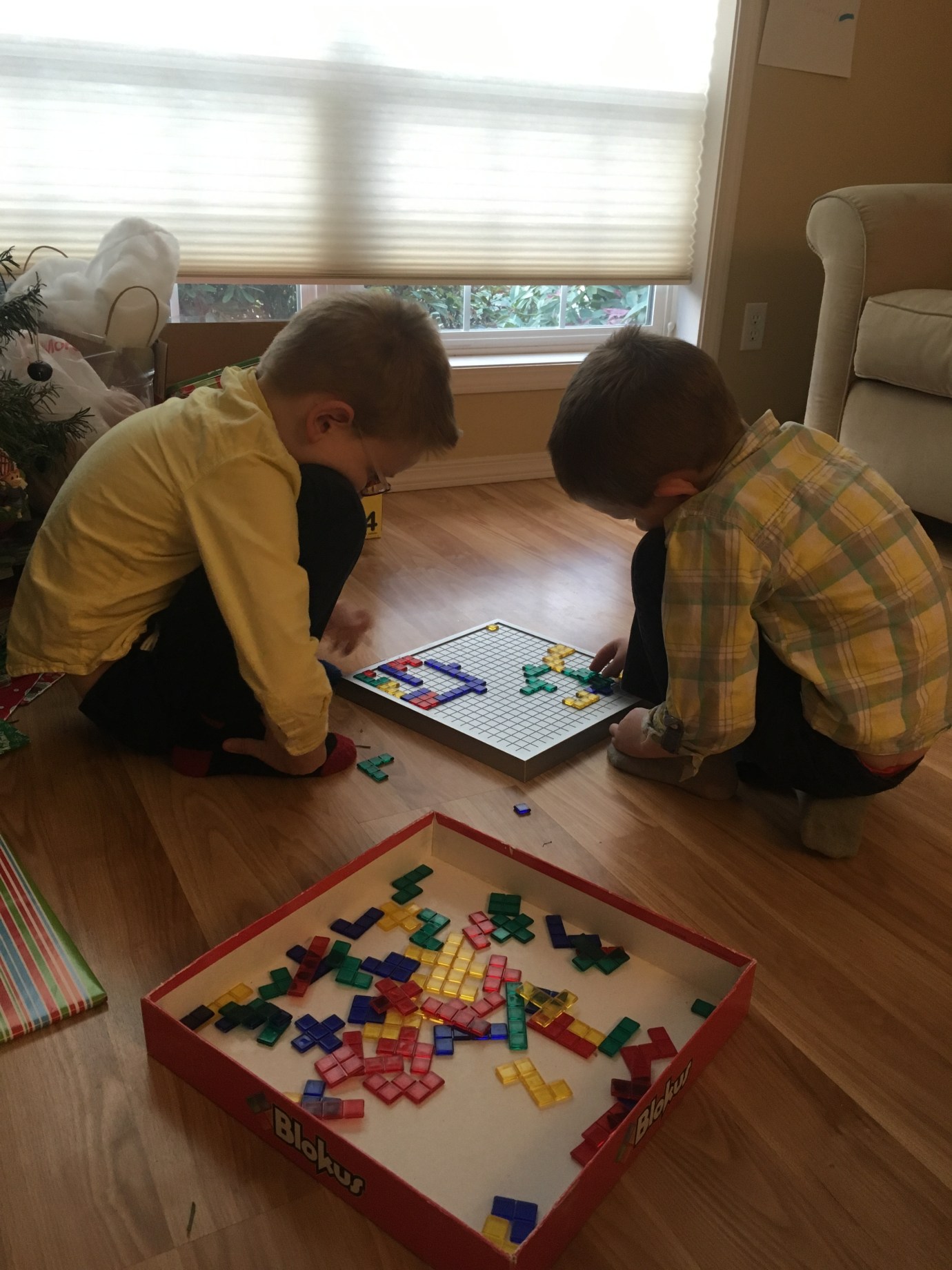
Playing Games for Christmas

Games are a great present for Christmas. A brand new game can bring energy to the house, and will create great memories. When I was about eight, my family got Hero Quest for Christmas. (Super nerdy, I know. Check out the classic early nineties design).

hero-quest

Every day, right after lunch, my brothers and I sat around the table with our dad and played one quest. I still remember the quest when an invincible ghost appeared. It could only be defeated by a certain sword. I had it! As an eight year old, I loved the feeling of working together to a common goal: defeating our dad.

How do you create these moments in your home? Here is what you should do.

  1. Pick the right game
    1. Fits your Christmas crew
    2. Long enough
    3. Replayability
    4. Full participation
  2. Plan time
  3. Prevent fights with food

Picking the right game

Choosing the right game can really help. I recommend checking out this Holiday Gift Guide from the BoardGameFamily. Trent lists out 11 different categories that will help you pick something that fits your Christmas crew perfectly.

You’ll need to pick something that gets people together. The game should be longer than 30 minutes, but not so long that people aren’t interested in playing again.

Replay-ability is also key. Some games are really fun, but you don’t really want to play them again right away. Hero Quest was fun because each quest was different. Dominion is another great one. Each play is almost a completely different game. The key here is finding a fun game, that takes long enough, that can be played lots of times over the holiday.

Lastly, it needs to be a game that doesn’t have long turns and that everyone can play through the whole game. (Risk is very fun, but once you are out, you are just sitting around)

Plan time

I can’t stress enough how important it is to set aside specific time every day during the holidays. We did it every day after lunch. It also works well to play to play every night after cleaning up dinner.

The kids (and those of us who are kids at heart) will appreciate looking forward to the time.

Prevent fights with food

Games add a lot to our lives, but they also can add some tense moments. When someone clobbers you in Blokus, (LINK), or eliminates you early in Bang, you have to have a positive attitude, and it really helps if there are snacks around.

What other ideas do you have to make game playing a part of the holidays?

Blokus Strategy

At our house, the kids play Legos for hours. Annabelle (8) and Josh (6) will spend hours building towers as high as they are. Isaac (4) can’t compete with the older kids. Sometimes he ends up knocking over their towers because of it.

There are two different intrinsic needs happening here. The desire to create; then second, the desire to feel in control. These two needs affect your Blokus strategy. The game is called Blokus, so you are naturally going to want to be a Blocker, and knock down opponents towers, but a straight blocking strategy will impede your own ability to create as a Builder.

Are you a Builder or a Blocker? To win this game, you need to be both. Here is the strategy.

  1. Get out quickly
  2. Play your 5 tiles first
  3. Share space (Builder Strategy)
  4. Block conservatively (Blocker Strategy)
  5. Watch closely

Get out quickly

Get into the middle, and into other peoples areas quickly. After playing a few times, this will be natural. You may be tempted to stay close to home. DON’T DO IT.

Play your 5 tiles first

My wife, Mallory, pointed this out to me, but if you don’t play your 5 tiles first, you end up running out of space for them later.

Builder vs Blocker

Blokus works best if you play as a builder. You do this by playing pieces so that your corner and the opponents corners are touching, allowing you both to play off of the connection. As you can see below.
img_0022You may be thinking, but the game is called Blokus, shouldn’t I be trying to block?

You are thinking like a Blocker. There is certainly a place for that in this game, but often when you Block. Not only do you anger the Builder you are playing with, but you also leave yourself open for another block.

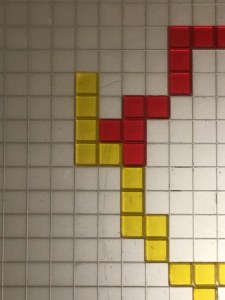
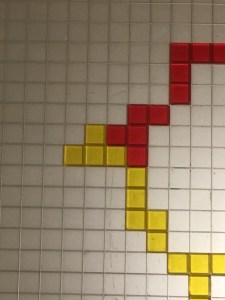
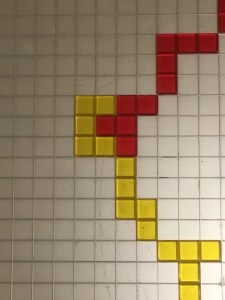
Suppose you are yellow, and it is your turn. What do you play? There are three good options.


Option 1. Good (Blocking only) It is pretty satisfying to block them completely, but it leaves you open for a bad follow-up block.

img_0023img_0024

Option 2.  Better (Building Only) This leaves you open for more moves. There is no possible way for them to completely block you on that side.

img_0026

Option 3. Best (Building and Blocking) Not only do you block them on many points, you also leave yourself open to get into their area. This satisfies the desire to create, and the desire to dominate. (We call that piece the clobberer, because it works so nicely.)

img_0027

General game play

Once you decide to mostly act as a builder, the game will go much more smoothly for you. you will always have an opening, and won’t often get trapped early on.

Later in the game, space gets limiting. Look around and match your pieces with spaces. If you have a space completely open and no one can take it. Don’t play there until later. Target areas that are contested to ensure that your tiles are played where you planned them.

And if possible, save your 1 piece for as long as possible. There is nothing worse than getting to the end and losing because your wife saved her 1 piece. Let that be a lesson to you.

Thanks for reading, do you have any other Blokus strategies that have worked well? Any Blockers out there that are successful?

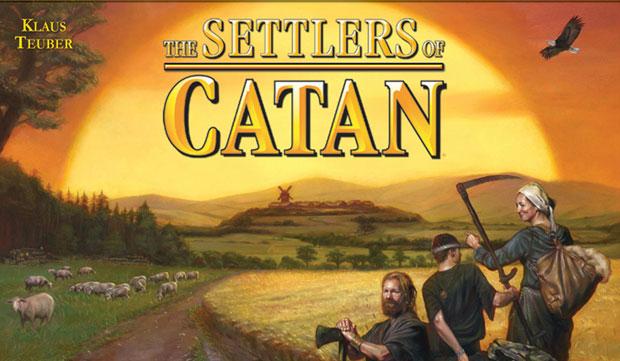
Settlers of Catan Strategy

Settlers of Catan brought strategy gaming back into popularity. Before Settlers game out, the same games had been played for years. This game is so fun. I like to call it the Harry Potter of board games. Have you ever noticed how after the success of Harry Potter, a lot more great young adult fantasy books started popping up everywhere? The same works in the Board Game world. This game was so popular, that it made board games main stream again.

The strategy is pretty complex because it really depends on how the board is set up, your turn placement, who you are playing with, and how other people choose to play. This is one of the great things about the game, but makes it more difficult to write a succinct strategy. Instead, I’ll give some good guidelines on how I try to play.

  1. Get Stone and Wheat in your first placement
  2. Build Cities quickly
  3. Trade often
  4. Play the robber evenly
  5. Hide your lead until the end
  6. End the game quickly

Stone, Wheat, and Cities

Obviously, it is best to have your settlements on the highest rolling spaces. Don’t disregard that plan, but if possible, play on Stone and Wheat. The purpose of this is to build Cities as fast as possible. It really puts you at an advantage to have Cities right from the start. It takes the least amount of resources to give you the most payout quickly.

After the Cities are up, it also allows you to pull development cards to plan for Step 5 and 6.

Trade often

This game is all about trading. If you have the constrained resource, be willing to trade it with anyone, but make sure that they give you at least two, and maybe 3 for it. Be generous by saying things like. “I’ll give it to you for wood (the one you want) and any other resource. That gives them the choice, but still nets you more cards.

The only time to be stingy with trading is when someone has an obvious lead. At that point, under no circumstances are you to trade with them. They, or you, are on their own at that point.

It may also be nice if you get a 2 for 1 port. You can convince people to give you 2 of that one, plus a free card to get something back for them.

Play the robber evenly

People have this innate reaction if they feel that they have been slighted. If you consistently place the robber on the same person, they end up having a knee jerk reaction to play it back on you. Sometimes they won’t even trade with you!

To get around this, play the robber on the spot that covers the most people, or bounce it around each time. Say something like, “I played it on A last time, so I’ll put it here this time.”

As long as it is fair, retribution can be minimized.

Hide your lead

If you are too far ahead, you become “that guy” and no one trades with you any longer. They also start stealing your cards with the robber. To avoid this, stay just ahead of people. the development cards really help with this.

Often you’ll pull the Soldier cards. Use these to get yourself out of a bad robber situation, and save one or two to sneak and get the largest army points.

Other times you’ll get the extra roads card. Use this towards the end to steal the longest road.

Sometimes you will even pull the free victory point cards. Great day! Hold these to the end to cross the 10 point finish line.

When you have 6 visible points, now is the time to plot how you are going to win, by getting the longest road, army, or laying your victory point cards. Everyone will look around confused, as you complete your path to victory

What other strategies have worked well for you?

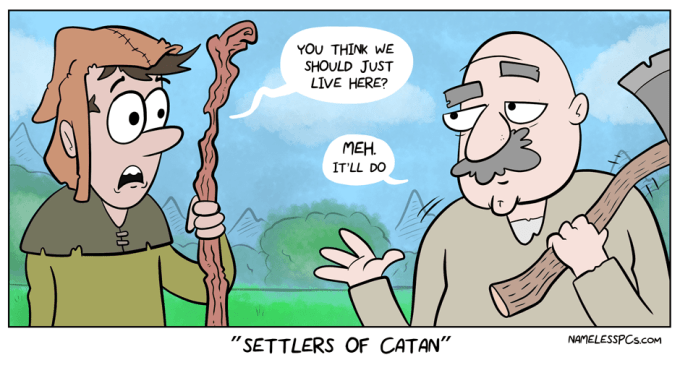
Also, since it is Friday…

2015-11-16-settlersofcatan

NamelessPC

Gaming with children

My church is launching a Light the World program for the month of December. The idea is to serve in 25 ways over 25 days during the month of December. In following that theme, I encourage you to serve a child by playing a game with them.

Think back on your childhood. Where did your love of playing games come from? It probably started with your parents playing with you. If not them, was it a sibling or a friend that introduced you to board games?

My dad often played games with us, but I remember the first time I ever got to attend one of his real game nights. A bunch of the youth from church came over to play an intense game of Risk. I had played once or twice before, but never a serious game. I went into the game pretty nervous.

My dad was my partner, and he guided me through the play. I wasn’t the first one eliminated, but I definitely didn’t win. This was a great memory. If I was going to be like all those wise teenagers, I would have to learn how to play games well.

This leads me to the strategy for playing with children, regardless of the game. Your purpose as the adult is to help guide them through the game process in such a way that the following things occur:

  1. They learn how to play
  2. They feel loved by spending time with you.
  3. They have fun.
  4. They gain a love for board games.

Notice how I didn’t say anything about you winning? Of course you can beat them in games. You are the dad, and they know you are awesome. The important thing here is raising children that will want to play games with you when they are older and can actually beat you. Here are a few strategies that help without letting them win. (No one wants to realize that they only won because you weren’t trying.)

  1. Change the rules to give them an advantage.
  2. Play on their team against another sibling.
  3. Play games that are mostly luck.
  4. Stack the deck against you.

Change the rules

When I was growing up, we had the Stoker Olympics (situps, pushups, stepups). We made the competition fair by giving the younger kids a handicap. It ended up being a competition of who improved most. This is what you do with games.

Some games lend themselves well to changing the rules. You could let them draw two cards instead of 1. You can let them roll twice and take the better of two roles. You can give them extra money, or let them see your cards, but don’t look at theirs.

The options here are limitless, and it allows them to know that you are trying your hardest, but giving them a slight advantage.

Team play

Being a kids teammate is great for meeting three of the four criteria, but some kids don’t feel like they have as much fun when you are coaching them along. Watch for this. If this is happening in your family, it may be time for you to back out and just let them play.

Play luck games

Some of the best games for kids have no skill at all. These are perfect for kids because they can legitimately win! Candyland is one of my kids favorites. It is pretty painful to play. “You are just moving along, and then you draw plumpy”. We adapted it so that you never have to go backwards. If you draw plumpy, your character goes back and has a “snack”, then moves right back to where they were. This really helps everyone to have fun.

Stack the deck

Sometimes you just have to stack the deck. It is actually quite fun to try to win after setting up your children to get most of the good cards. You can even play up the discrepancy by saying things like, “Awe man, I got the 2 again. That’s the 3rd time in a row!” They love it. and laugh and laugh.

Your competition of tomorrow are your children today. So play a game with a child, and make it great.

Please comment and let me know how it went.


Monopoly Strategy

I introduced Monopoly to my 4 year old Isaac, and my 6 year old Josh.We picked guys, and Isaac said. “I want to be this trash can.” (apparently, we haven’t introduced them to thimbles.)

Monopoly feels like a lot of luck, but there is a lot of strategy. The secret to Monopoly is COOPERATION. That’s right. You can’t win this game by yourself, unless you are super lucky and land on monopolies. The strategy is below.

  1. Buy every property you land on.
  2. Trade for a monopoly
  3. Conservatively build up your monopoly into hotels
  4. Take properties in place of payment from bankrupt opponents
  5. End Game

Buying properties

Throughout the game, you always want to buy the properties you land on. Even if you get low on money at the beginning, it will pay off in the long run.

Create monopolies

After you’ve gone around the board twice, you should have two of a set of monopolies. If not, go around again to get two. Target the properties on the second and thirds side as you will be able to build them up to high value properties very quickly.

Once you have two of a property, someone else most likely has the third. Do what you can to get it. You may have to sacrifice a little to get it. Trade your park place to the guy with Boardwalk for the property you want if you have to. (This actually works well because it is pretty difficult to build up the Boardwalk and Park Place properties, so you could have hotels before they even have a few houses.) Often you’ll have to give someone else a monopoly to get yours established. This is part of the game, and is where a lot of the luck comes in.

Build into hotels

When you have some money, build a few houses and hope for cash flow to come in. Don’t build so fast that you go bankrupt on one role of the dice. Anytime someone lands on your properties and pays out, invest a little bit into building your properties. (This is like life. When you get your paycheck, pay your bills, tithe a little, invest and save.)

Acquire properties through bankruptcy

After awhile, you can start bankrupting people when they land on your properties. If they have any properties you want, suggest that they can relieve some of the payment by giving you the properties instead. If they won’t, you can’t show any mercy. Make them pay the full amount through mortgaging and selling houses and hotels.

Side note: The no mercy rule should actually be enforced all of the time in Monopoly. The problem with this game is that it takes so long to play. This is caused by mercy and free parking. Mercy at bankruptcy just extends the game, making it painfully drag on. The house rule of putting money on Free Parking makes the game take longer because people get a boost right when you almost have them out of the game. I know a lot of people love this aspect, so don’t fight it to much, but know you know why the game is so long.

End game

The end of the game can come slowly. Usually, a few of the players will be out, and it is just a matter of time and luck to get the last person out. (That person is often the original girl you traded with to get your first monopoly). You just have to wait it out. There isn’t much you can do to speed the end game. If you can land on the jail space. Stay there. Jail is the safest place at the end of the game.


Alternate end game.

We have thought about implementing alternate end game conditions in our house to shorten the game.

  1. Allow people to retire. (take the money you have and the properties you have, and leave the game. That amount of money and properties decide your final score.)
  2. Stop the game after someone goes 20 laps. Most total assets wins
  3. Hand out properties at the beginning randomly. (isn’t an end game condition, but skips stage 1 of the game.

Anybody else figured out alternate ways of playing to make the game go faster, but still maintain the overall structure of the game?

Ticket to Ride

When I hear Ticket to Ride, I can’t help but start humming the old Beatles song. “She’s got a Ticket to Ri-ide”. Now that that is sufficiently stuck in your head, we are ready to figure out the strategy for the game.

Ticket to Ride is an excellent game. It is fun to play even if you don’t win. It feels like you are accomplishing things as you go along, and the game play is fast enough that you aren’t waiting for ‘that guy’ to finish his turn. There are a few different strategies that work, but there are few things that have to happen if you are going to win. Here is the strategy.

  1. Start with one long cross country route
  2. Plan your routes to take advantage of 6 train placements and path redundancies
  3. Usually take cards that you need instead of taking a wild.
  4. Watch carefully and keep track of what others are drawing
  5. Play trains when there aren’t any cards you need
  6. Focus on paths that are critical for your route
  7. After completing routes, draw additional routes routes that will connect to your system of trains
  8. Always be aware of remaining trains
  9. End the game happy

Starting the game-Longer is better

In the original USA version of the game, you can’t really win without having a long >19 point route. Not only do you miss out on the high points from the route, but you also miss out on the 6 point paths when you don’t go cross country.

The game isn’t really about completing a bunch of different routes. It is about creating a network of connected routes that utilize the same paths. This is how you rack up the points and still have enough trains to finish all your routes

Six train paths

The Six train paths are worth 15 points! These are way better than most of the smaller routes. So if you can choose the path, go for the six trains.

Drawing cards

If something comes up that you need, even if it isn’t in your top of mind path; pick it up. It is almost always better to take two cards than to take a wild card. Also, you don’t need to play trains unless there is danger of losing a path. (Only take a wild if you have to play trains next turn or risk losing position.)

Watch people

People are often single minded. Therefore, you can see from their eagerness and by what they draw, how much they need a color. If you are going for a six red route, and someone else keeps taking all the reds, be careful. You either need to move quickly and steal the route first, or you need to figure out a different way around that path quickly.

Play trains

My two year old often comes up to me and says “Play Trains?” The answer is yes.

When there isn’t anything that you want to draw visible, it is a great time to play trains. It doesn’t waste a turn drawing cards you don’t want, and can set you up for success. When you play, choose paths that are critical first. A critical path is one that you must have to get into your city. Crowded cities are LA, New York and sometimes Seattle. Get good placement into these cities early on.

Drawing new routes

Don’t be afraid to draw new routes. When you do, take advantage of what you have already created on the field by only keeping routes that don’t take much effort to capture. This isn’t foolproof because sometimes you have to keep something you don’t want. Don’t despair. Act like you are doing well, and it will force other people to draw more routes to compete, even if they aren’t ready to do so.

Side note: don’t draw routes just because other people are doing so. You are playing your own game.

End game

One of the worst things that I see people do is taking routes that look easy, but then they run out of trains, or someone, (me!!) ends the game before they get to complete them. Keep an eye on the trains. If someone else is almost done, it may not be worth it to draw new routes.

If you planned your routes carefully, you should be almost out of trains when they are all completed. This gives you the power to end the game. If you can, end it quickly. This blindsides everyone, and can give you just the advantage you need.


Additional thoughts

Don’t play mean. If you are playing with more than 2 people, playing on a path that you don’t need may hurt someone, but will actually hurt you as well. You are going to need all your trains for your routes. In a two player game, you can actually play aggressively and end up winning, albeit with low points, but you may not get another game with your opponent.

Comment below if you have any additional strategies that have worked well for you.


Stratego Strategy

In the old days there were really only a few games that everyone owned. The main ones are still best sellers today. (Monopoly, Risk, Stratego, Battleship, Scrabble). I played these games over and over with my siblings and my dad. Stratego was my favorite.

I remember playing over and over again and beating my dad, but never beating my older brother. As a dad now, I realize that my dad may have let me win. When I was about 11, I decided I wasn’t going to lose anymore and I came up with a strategy that has worked many times since. I have only lost twice since then, and I’ve learned from both losses that I’ll mention below.

This is called the Straight Across Trading Strategy (comment if you have a better name for it.)

  1. Always cover your flag with bombs.
  2. Never block your flow of traffic with bombs
  3. Safely randomize where  you put your flag, but usually towards the back.
  4. Randomize your other pieces, but ensure that you have scouts towards the front
  5. Play conservative in the beginning until you have one piece up on the opponent
  6. Once you have one piece up, kill his 1 with your 1. his 2 with your 2, his 3 with your 3, until you have a piece that cannot be killed.
  7. Only attack pieces that move.
  8. Eliminate the opposition

Most people try going for the flag in Stratego, and most people expect you to be looking for their flag. In the end, you win if all their guys are dead which makes for a much more systematic win. I’ll describe each piece of the strategy below.

Bomb Placement

After developing the Straight Across Trading Strategy, the first time I lost, I was cocky and left my flag open on one side. I was implementing the strategy and was killing all of the other players guys systematically, and he went for broke. He slipped a guy down the side and went straight across the back, killing everyone. If I would have played properly, I would have had a bomb in the way of the flag, but I didn’t. He won that one.

Don’t make the same mistake. Protect your flag.

Secondly on bomb placement. Some people try to be cute and put bombs on the front line, or just behind the lake. Sometimes you get lucky and they will attack with a high guy on your bomb, but if they are playing conservatively, it won’t ever work, and you won’t be able to move your guys where you want them.

Randomize Flag Placement

It doesn’t really matter where you put the flag, as long as it is in the back row, and protected by bombs. If you don’t move it around in subsequent games, they may win on an all our rush, so just randomize.

The rest of your guys just randomize conservatively. It helps to have scouts towards the front to gather intelligence. It helps to have your 1, 2 and 3 accessible, but not on the front line, but once again, you don’t want to be predictable.

Conservative play

Don’t reveal your strongest guys early on. You really want to test around with your scouts until you find someone good to kill. (anyone from 6 and lower can get you going on the trading strategy).

Kill the target with someone strong (consider using your 1 or 2, just don’t let them lure your 1 into a spy kill. That is the worst.)

Trade Across

Once you reveal your high guy, watch their eyes. They will always look at their 1 or spy to see how to kill you, then once you draw out their 1, don’t even worry about using your spy. Use your 1 and go straight for the kill (watching out for their spy).

With your 1 and his 1 dead. Start using your 2. Your 2 basically has  free reign to kill anyone that moves. Eventually, they will have to use their 2 to stop you, but then you bring out your 3s. Keep up the strategy, trading for their 3s if they show up. Eventually, you have a guy that cannot be killed. At this point, it is just about mopping things up.

That’s it!

Epilogue

I said I would explain my second loss.

I always joked with my family that I wouldn’t marry anyone that couldn’t beat me is Stratego. I met a girl and fell in love. She loved playing games, but just couldn’t beat me. We played about 8 games of Stratego and number 4 was pretty close. Game 5 I played to combat what my future wife had done in game 4, but she didn’t do it again.

I didn’t think to much about it, and we played a few more games. We got engaged, but she still hadn’t beat me. About a week before our wedding, we were playing again, and she used her game 4 strategy, but I wasn’t prepared for it. “It’s a trap!” She had been sandbagging games 5-8 so that I would forget about the strategy she used. She ended up taking the win. (We are happily married with 4 great children…and have never played Stratego again.)

Anyone else have a strategy that has worked well for you? Anyone else been defeated by your wife? Comment below.
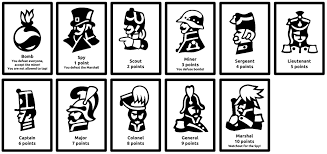
stratego-guys

(Footnote: the new version of Stratego has the strongest guy as a 10 instead of a 1. Flip the numbers in your head. Same strategy.)



Strategy for your Strategy

When I was young, my older brother was two years older than me and always beat me in games. Once, he created his own game and didn’t tell me any of the rules. While he rolled dice, chipping away at my base, I sat there in confusion. Eventually, he said, “aren’t you going to defend yourself?” At that point, I lost it. I jumped across the game board and attacked my brother. (I’ll show YOU defend yourself). Unfortunately, he was also bigger and stronger than me, so it didn’t end well. This event helped to shape me.

So you want to win at games? Tired of losing to your older brother, next-door-neighbor, boyfriend, girlfriend, neighbor?

You need a strategy. And to start with, you need a strategy of how you are going to get a strategy. Here are some strategies to develop your strategy.

  1. Always read the rules BEFORE the game
  2. Pay special attention to the winning conditions
  3. Set yourself up early for success later in the game
  4. Learn from your failures
  5. Be positive.

Read the rules

When you show up to a game night, often people will suggest a game you have never played. This isn’t a problem, but if you use the game as your “learning” game, you won’t win. Also, if you count on someone else to explain the game to you, you miss out on all the tiny details of how to win and how cards and pieces and players interact. You don’t have to take half an hour to delay everything, just take some time to read them.

Winning conditions

Winning conditions matter. Some games end as soon as the last card is drawn. Some end when all your guys are dead. Sometimes you get extra points if you held onto the small piece and played it last. You need to know how to win to be able to win.

The long game

It doesn’t matter if you get up a little at the beginning of the game if you don’t plan a strategy that will last through the whole game. Figure out the following:

  • What should you do at the beginning to set your self up for the remainder of the game
  • What is your interim strategy, how do you you sustain yourself through the game to get to the end in a position to win
  • Towards the end, when do you need to make the moves to end the game or get the most points possible before it ends.

Learn from your failures

You won’t win every time. Maybe you planned out a strategy that you thought was great. Maybe it really was great, but someone else got lucky. Or maybe you need to tweak your strategy. That is OK. Don’t jump across the board and attack. Just say, “Good game”. BUT, that isn’t the end. Keep tweaking your strategy until you figure out what works well for you to win

Win and lose well

If you win, tell everyone they played well. If you lose, tell everyone they played well. There is a delicate balance between dominating the competition and being a fun person to play with. If you aren’t fun to play with; eventually, no one will play with you.

And, it is the right thing to do.